Civil Service Online Tests
the Judgement Test (CSJT), Numerical, Verbal and Work Strengths Tests Explained
The UK Civil Service sets the same online tests across thousands of job adverts. The Civil Service Judgement Test (CSJT) rates four actions per scenario, the Numerical and Verbal tests are adaptive and untimed, and the Work Strengths Test mixes ratings with most/least choices. Formats, pass marks, banked scores, Success Profiles and free practice.
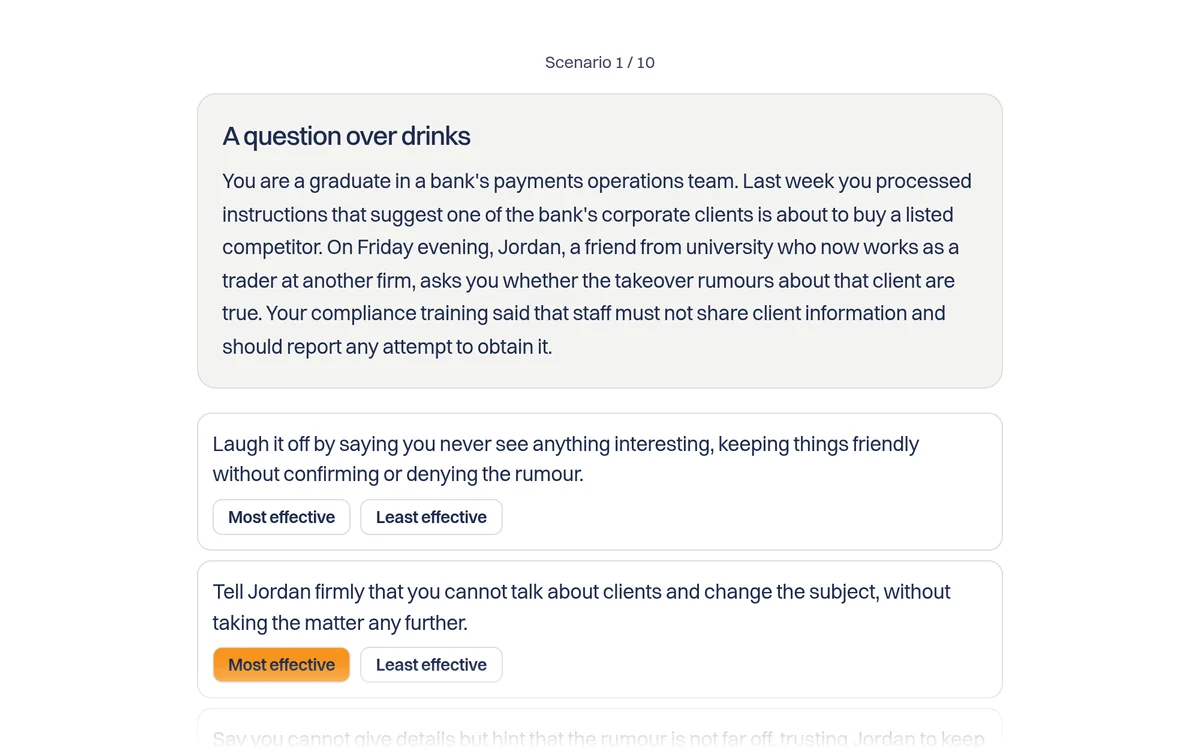
The Civil Service Judgement Test (CSJT) is an online situational judgement test: you rate four possible actions in each workplace scenario as Counterproductive, Ineffective, Fairly Effective or Effective, after a short self-assessment worth 15% of your score. It is untimed, and GOV.UK suggests allowing "at least an hour" (GOV.UK, CSJT). It sits beside the Civil Service Numerical Test and Civil Service Verbal Test, which are adaptive and also untimed, and the Work Strengths Test, which reads what you do well and what motivates you. The job advert says which ones you will take. Every result is a percentile against other applicants, and the pass mark can rise after the closing date. Each test has an official unscored practice version; take it first. For the formats, our free situational judgement test, numerical reasoning test and verbal reasoning test are the closest GamePrep practice.
Civil Service online tests at a glance
GOV.UK lists eight online tests, each with a practice version (Civil Service online tests). The Civil Service blog calls seven of them "commonly used" (Civil Service blog, 2024). This table covers the ones most adverts ask for; grades and timing come from GOV.UK's guidance for recruiters.
| Test | What you do | Timed? | Grades it is set for |
|---|---|---|---|
| Civil Service Judgement Test (CSJT) | Self-assessment, then rate four actions per scenario on a four-point scale | No | AA/AO, EO, HEO/SEO, Grade 7 |
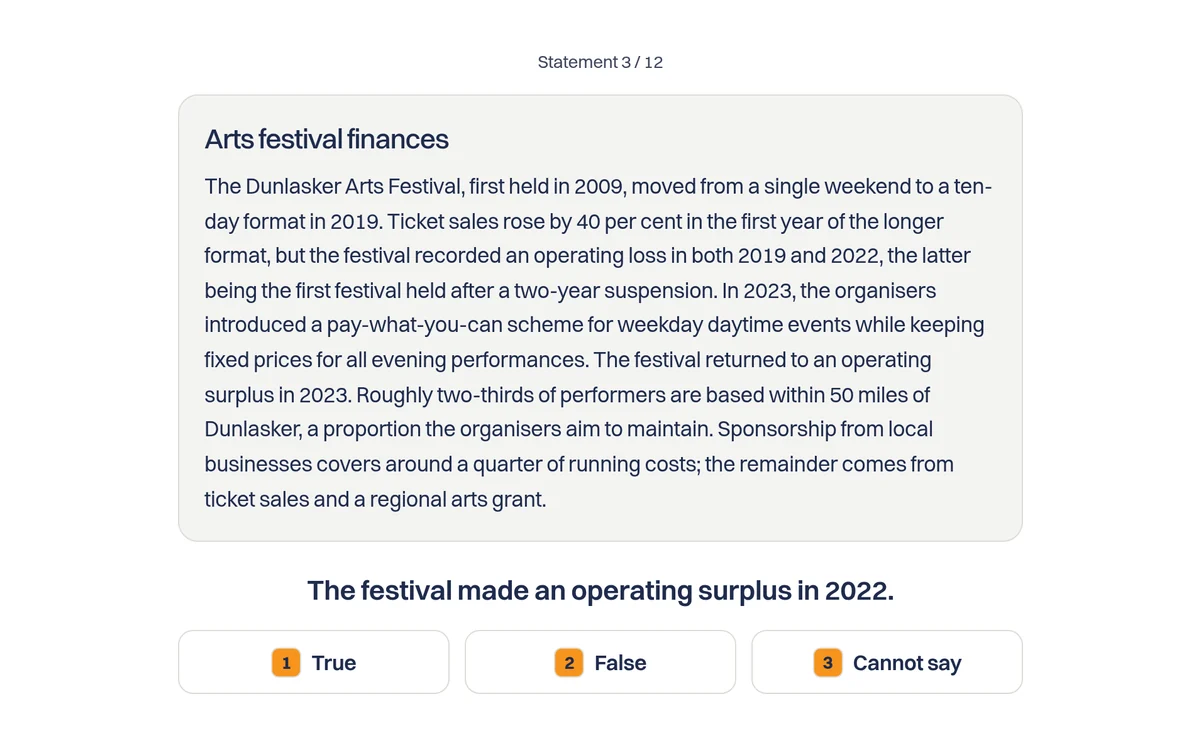
| Civil Service Verbal Test | Read a passage, decide True / False / Cannot Say; adaptive | No | All grades |
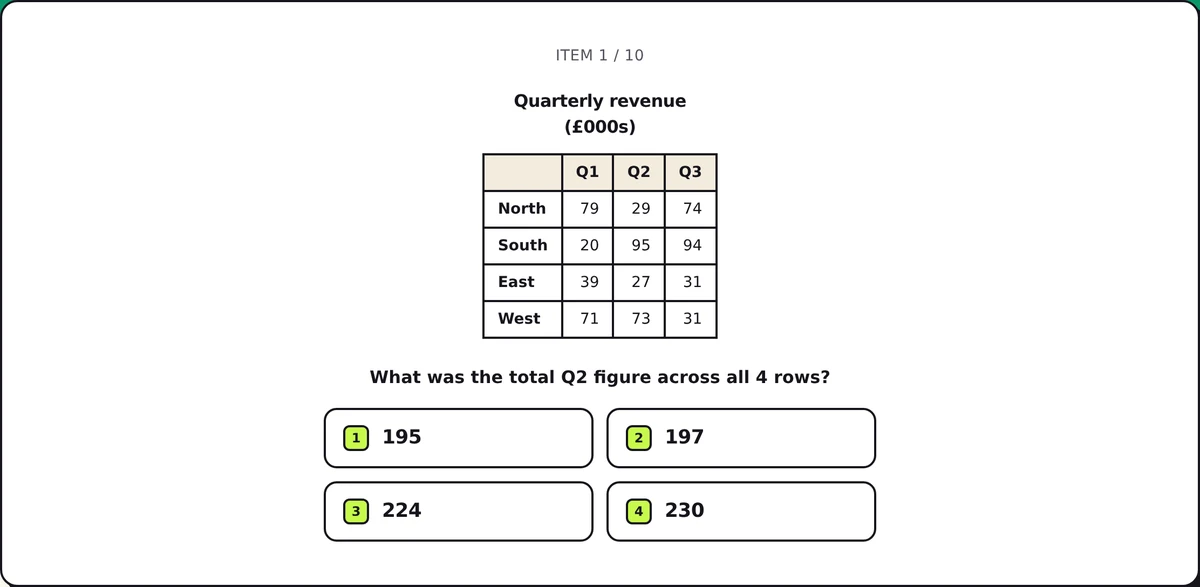
| Civil Service Numerical Test | Graphs and tables, pick the right answer; adaptive | No | All grades |
| Civil Service Work Strengths Test | Agree/disagree statements, rate actions, then most/least likely | No | All grades, in two level bands |
| Management Judgement Test | Judgement scenarios for managers | No | EO, HEO/SEO |
| Customer Service Skills Test, Casework Skills Test | Role-specific skills | Yes | Mainly AA/AO and EO |
GOV.UK adds that "no specialist knowledge or experience is needed" for any of them.
The Civil Service Judgement Test (CSJT)
GOV.UK describes the CSJT as "an online situational judgement test" that measures judgement and decision-making against the Civil Service Behaviours for the job (GOV.UK, CSJT).
Part 1: self-assessment (15%). Questions about your typical work behaviour and preferences, covering ambition, motivation and flexibility. GOV.UK warns that you may be asked about these answers at interview, so answer honestly.
Part 2: scenarios (85%). For each behaviour in the advert you get three scenarios, and each asks you to rate four actions. Scenarios are text, video or a mix, and you only see ones relevant to the job level you applied for. The four ratings are defined like this (GOV.UK):
| Rating | GOV.UK definition |
|---|---|
| Counterproductive | "An unacceptable action that would make the situation worse" |
| Ineffective | "A poor action that would not help the situation" |
| Fairly Effective | "A useful action that would be of some help to the situation" |
| Effective | "A good action that would help to resolve the situation" |
Two rules matter more than any tip: rate every action on its own, and remember that several actions can share a rating. If two of the four would genuinely help, both can be Effective.
Timing. Not timed. "Most people take between two and four minutes to answer one scenario", and GOV.UK recommends an hour in all. You can relaunch the test if your browser closes, but only a limited number of times, so do it in one quiet sitting.
A CSJT-style example (written for this guide)
You are leading a small team. A colleague tells you that a report due to a minister tomorrow contains a figure she now thinks is wrong. Your manager is on leave.
- Send the report as it is and raise the error after the deadline. Counterproductive: it knowingly passes on a wrong figure.
- Ask the colleague to check the source data now and, if the figure is wrong, correct it and tell the recipient what changed. Effective.
- Email your manager on leave and wait for a reply. Ineffective: it delays without solving anything.
- Flag the issue to the senior officer covering for your manager and agree whether to delay or correct. Fairly Effective to Effective, depending on the behaviour being assessed.
The pattern the CSJT rewards is visible: face the problem, check the facts, be open about what changed, and involve the right people without passing the decision up for no reason. The Behaviours in Success Profiles describe the same thing.
The Civil Service Numerical and Verbal Tests
Both work the same way, and GOV.UK covers them on one page (GOV.UK):
- Verbal Test: read a passage, then decide whether a statement is "true", "false" or you "cannot say". Our verbal reasoning guide explains the three rules and the False-versus-Cannot-Say trap.
- Numerical Test: graphs, tables or other numerical information, then a multiple-choice question. Keep "some rough paper, a pen and a calculator to hand". See our numerical reasoning guide.
- Adaptive: "The tests adapt to your performance." A correct answer may lead to a harder question and a wrong one to an easier question, so the test is usually shorter than a fixed-length one and feels hard by design.
- Untimed: "your score is not affected by how long you take". Most people take 15 to 45 minutes per test; allow an hour each.
- No skipping or going back, and some unscored trial questions are mixed in.
- English or Welsh, chosen at the start.
Because time does not count, the winning strategy is accuracy: read each passage or chart twice, and check your arithmetic before you click.
The Civil Service Work Strengths Test
Strengths are one of the five elements of Success Profiles: "the things we do regularly, do well and that motivate us" (Success Profiles). The Work Strengths Test has three parts (GOV.UK):
- Statements about your work behaviour, rated from "very strongly agree" to "very strongly disagree".
- 10 scenarios, each with four actions rated on the same four-point scale as the CSJT.
- 5 scenarios where you pick the action you are most likely and least likely to take.
It is untimed (again two to four minutes a scenario, an hour in all). Part 1 is closer to a personality questionnaire: answer as your real working self, consistently. Our work personality questionnaire has agree/disagree and most/least sections in a similar style, and the personality tests for jobs guide explains why consistency matters.
Pass marks, percentiles and banked scores
- Percentiles. Every test compares you with "a representative group of applicants": GOV.UK's example is that "a percentile of 44 means you scored better than 44% of the group".
- Minimum standard, then a moving pass mark. You are told if you meet the minimum standard for the job level. After the deadline, the recruiter may set or raise the pass mark, and meeting the minimum "is no guarantee of an invite to continue the selection process" (GOV.UK, CSJT). There is no single published pass mark.
- Banked scores. A pass on the Verbal, Numerical or Work Strengths Test is banked, so you do not resit it for jobs in the same grade grouping (AA/AO; EO; HEO/SEO; Grade 7, Grade 6 and SCS 1). Banked scores expire after six months or when a new benchmark is applied, and a verbal score does not transfer to the numerical test (GOV.UK). The CSJT guidance page does not describe banking, because the behaviours tested change with each advert.
- Feedback. You get your score and automatically generated feedback for the CSJT, but never feedback on individual answers.
- Resits. If you do not pass, you can take the test again in a future application. You may also be asked to resit under supervision if invited to interview.
How Success Profiles fit in
Success Profiles is the Civil Service recruitment framework, with five elements: Behaviours, Strengths, Ability, Experience and Technical (GOV.UK). The online tests map onto it: the CSJT measures Behaviours, the Work Strengths Test measures Strengths, and the Numerical and Verbal Tests measure Ability ("the aptitude or potential to perform to the required standard"). Experience and Technical are judged from your application and interview. Read the advert to see which Behaviours are listed; they are the ones your CSJT scenarios will test.
Civil Service tests versus the Fast Stream
The Civil Service Fast Stream uses its own two online tests, Work-based scenarios and a Case study assessment, not the CSJT. They look similar (rate actions in a work situation), but they are separate. Our Civil Service Fast Stream guide covers them, along with dates for the 2027 intake. Some departments also use written or in-tray style exercises later in the process; see the e-tray and in-tray exercise guide.
How to prepare
- Take each official practice test linked from GOV.UK's online tests page. They are unscored and show the real interface.
- Read the advert's Behaviours and the Success Profiles definitions. Picture what doing each one well looks like at your grade.
- For the CSJT, rate each action against the situation, not against the other options. Ask: would this make things better, a bit better, no better or worse?
- Use the lack of a clock. Read every scenario, passage and chart fully. Rushing an untimed test is the most avoidable mistake.
- Practise the reasoning formats with our numerical and verbal tests, and the judgement format with our situational judgement test and the SJT guide.
- Start as soon as you are invited. GOV.UK asks for queries "at least two working days before the deadline".
- Do it yourself. "Your answers must be your own", and you must not ask anyone for input.
Applying through an apprenticeship rather than an advert? Our degree apprenticeship online assessment guide covers the wider picture.
FAQ
What is the Civil Service Judgement Test? An untimed online situational judgement test. A self-assessment worth 15% of the score is followed by workplace scenarios, three per behaviour, where you rate four actions each as Counterproductive, Ineffective, Fairly Effective or Effective.
How long does the Civil Service Judgement Test take? It is untimed. GOV.UK says most people take two to four minutes per scenario and recommends allowing at least an hour.
What is the pass mark for the Civil Service Judgement Test? There is no fixed published pass mark. Your score is a percentile against other applicants, you are told if you meet the minimum standard for the job level, and the recruiter may raise the pass mark after the closing date.
Are the Civil Service Numerical and Verbal Tests timed? No. Both are adaptive and untimed, and your score is not affected by how long you take. Most people take 15 to 45 minutes per test.
Can I use a calculator in the Civil Service Numerical Test? Yes. GOV.UK suggests having rough paper, a pen and a calculator to hand.
Do Civil Service test scores carry over between applications? Passes on the Verbal, Numerical and Work Strengths Tests are banked for jobs in the same grade grouping for up to six months. A verbal score does not count for the numerical test, and the CSJT guidance describes no banking.
Is GamePrep the official Civil Service practice test? No. GamePrep is independent and not affiliated with the UK Civil Service or the Cabinet Office. The official practice tests are linked from GOV.UK; our scenarios and questions are original practice in similar formats.
GamePrep is an independent practice site and is not affiliated with, endorsed by or connected to the UK Civil Service, the Cabinet Office or Civil Service Jobs. Test names are used only to describe the tests.