Game-Based Assessment Examples
30+ Real Games Employers Use, and Where to Try Them
Game-based assessment examples from pymetrics (Harver), HireVue, Arctic Shores, Aon, Criteria, Cappfinity and McKinsey: what each game measures in one line, and a free version of most to play.
Game-based assessment examples include the pymetrics balloon and digits games, HireVue's Numerosity and Shapedance, Arctic Shores' Predict and Security tasks, Aon's gridChallenge and digitChallenge, Criteria's Cognify games and McKinsey's Solve scenarios. Each is a short interactive task that records how you respond instead of asking questions. They fall into two groups: cognitive games with right answers (memory, attention, numbers, reasoning), where practice helps, and behavioural games with no right answer (risk, fairness, response to setbacks), where you play as yourself. Below is every game type we could confirm, grouped by vendor, with one line on what it measures and a link to our free version or guide.
What is a game-based assessment?
A game-based assessment (GBA) is a psychometric test delivered as a set of mini-games. Vendors say the games measure the same things as traditional tests, from a different angle. Arctic Shores, for example, says its tasks "are not games" but are "grounded in decades of psychological research and built on well-established experimental methods", where "every tap, click, or selection is a small decision" (Arctic Shores 2026 candidate guide). Most vendors do not publish their game names, so the names below come from candidates and prep providers unless we say otherwise.
pymetrics (now Harver)
Harver, which bought pymetrics in 2022 (Harver), sells "12+ interactive, gamified experiences" that take about "25 Minutes to complete" and measure "Effort, Risk Tolerance, Decision making, Attention, Focus, Learning, Fairness, Generosity, Emotion" (Harver).
| Game | What it measures | Try it |
|---|---|---|
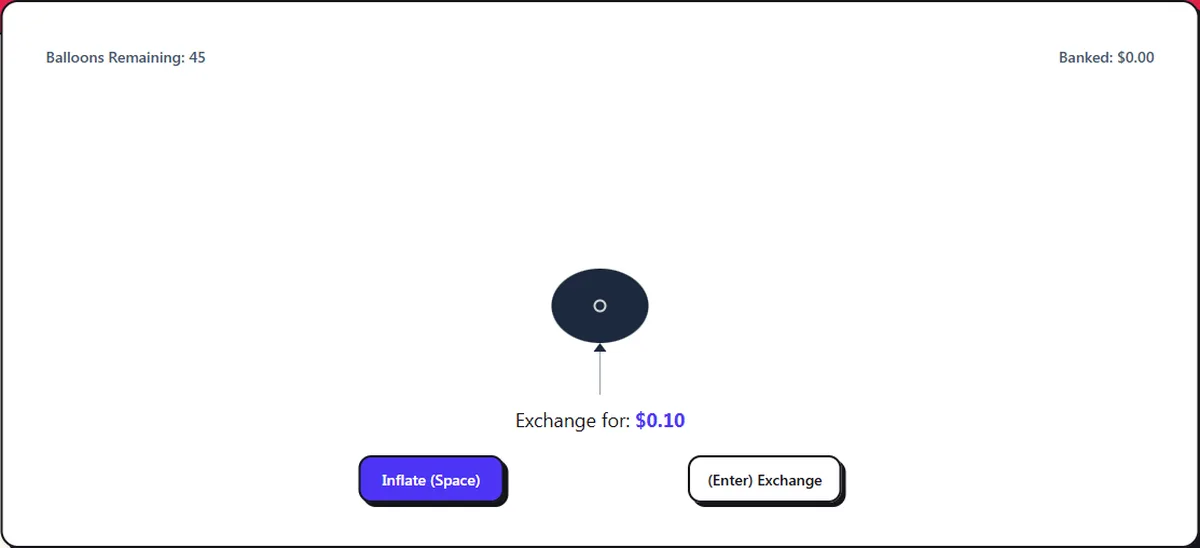
| Balloons | Risk tolerance and learning from earlier balloons | Balloon game |
| Digits | Working memory span | Digit span |
| Arrows | Attention and switching between rules | Flanker arrows |
| Stop | Impulse control (press for one colour, not the other) | Go/no-go test |
| Tower | Planning moves ahead | Tower game guide |
| Cards | Risk-taking and exploring versus sticking | Energy game (same idea) |
| Money Exchange, Hard or Easy, Keypress, Lengths, Faces | Fairness, effort, motor speed, attention, emotion recognition | No game needed: see the pymetrics games guide |
More: Harver assessments and Harver vs pymetrics.
HireVue
HireVue says its games cover "Personality & Work Style", "Working with People" and "Working with Information", are "each under 20 minutes", and adapt: "candidates advance or go back in levels depending on their performance" (HireVue). HireVue does not publish game names; prep providers list these (JobTestPrep):
| Game | What it measures | Try it |
|---|---|---|
| Numerosity | Number fluency: combine numbers to hit a target | Numerosity, guide |
| Digitspan | Working memory | Digit span, backward |
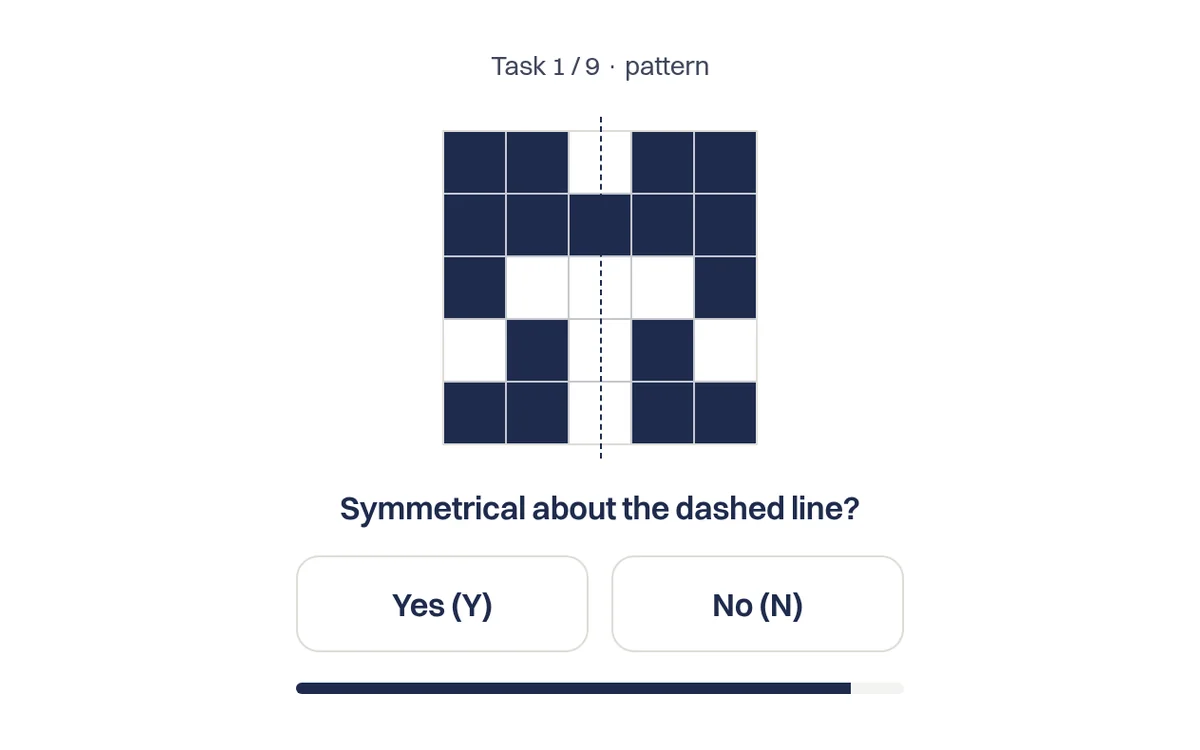
| Shapedance | Comparing rotated shapes | Shapedance rotation, guide |
| Singularity | Attention to detail: find the odd one out | Odd one out, guide |
| Pathfinder | Problem solving and planning a route | Pathfinder, guide |
| Flashback, Puzzle Picture | Working memory (holding and updating what you saw) | N-back (closest), guide |
| Portrait, E-motions, TeamChat | Work style, emotion recognition, teamwork | Play straight: see HireVue games explained |
Arctic Shores
Arctic Shores does not name its tasks either, but its 2026 guide lists the kinds you may meet: responding to shapes or numbers "as each new prompt briefly appears and disappears", "abstract patterns in shapes", "quantitative and mathematical concepts", "facial emotional expressions", timing taps "to the movement of a visual stimulus", and using feedback "to make a series of predictions". Each task takes "between 5 and 15 minutes" (Arctic Shores). The task names candidates report:
| Task | What it reads | Try it |
|---|---|---|
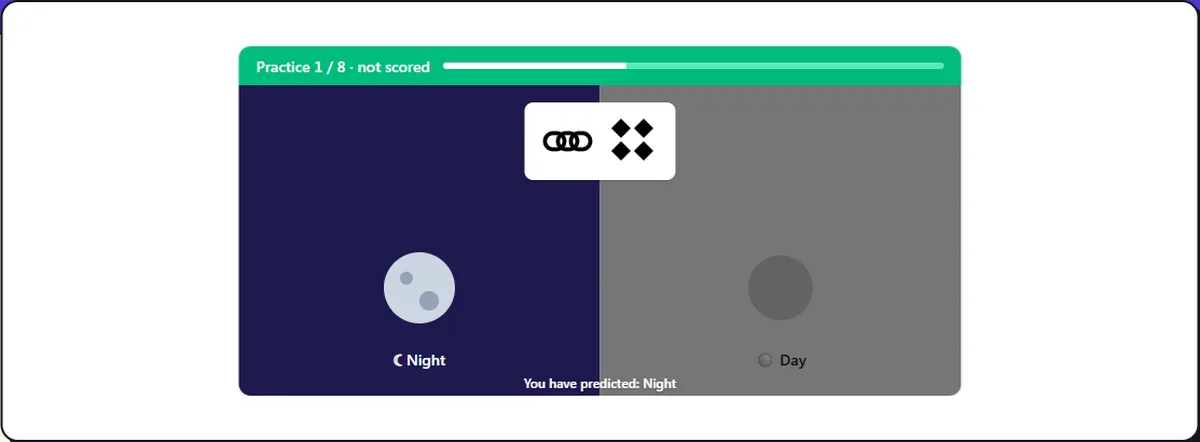
| Predict (day and night) | Learning from uncertain feedback | Predict game, guide |
| Balance | Numerical and logical reasoning with hidden weights | Balance game, guide |
| Order | Abstract (inductive) reasoning: build the next frame | Order game, guide |
| Security (lock) | Timing, plus persistence after setbacks | Lock game, guide |
| Direction (arrows) | Attention and response inhibition | Direction game, guide |
| Ticket | Switching between two rules | Ticket game, guide |
| Balloon | Risk appetite | Balloon game, guide |
| Energy (power generator) | Decisions under risk | Energy game, guide |
| Team Sales | Cooperation versus self-interest | Team Sales game, guide |
| Expressions | Labelling emotions on faces | No game; see the Arctic Shores guide |
How these become your feedback report is covered in Arctic Shores results explained.
Aon (cut-e)
Aon publishes its own list of candidate tests with names and times (Aon). The game-style ones:
| Game | Aon's description | Try it |
|---|---|---|
| gridChallenge | Working memory: retain information while processing other data (9 minutes) | gridChallenge practice, guide |
| digitChallenge | Numeracy: "solve basic arithmetic functions using mental calculation" (6 minutes) | digitChallenge practice |
| switchChallenge | Deductive reasoning: "identify the right 4-digit number sequences for receiving the right result" (6 minutes) | switchChallenge guide |
| motionChallenge | Planning: "plan ahead and to overcome barriers" (6 minutes) | Pathfinder (related skill) |
| gapChallenge | Deductive logic: fill the empty cell in a graphic (6 minutes) | Inductive reasoning (related skill) |
| chatAssess | A "gamified situational judgment test": reply to work messages (20 minutes) | Situational judgement test, SJT guide |
More: Aon / cut-e assessments.
Criteria Cognify
Criteria says Cognify has "three highly engaging and interactive games" (a six-game version is "available on request") that take "just 10 minutes to complete, plus tutorials", and measure "a candidate's ability to solve problems, work with numbers, and correctly interpret and edit written text" (Criteria).
| Game type | What it measures | Try it |
|---|---|---|
| Problem solving | Planning a route to a goal under constraints | Pathfinder |
| Numbers | Fast numerical judgement | Mental math, Numerosity |
| Written text | Interpreting and editing text | No direct game; see the Cognify guide |
McKinsey Solve
McKinsey describes Solve as "a gamified assessment created to showcase your problem-solving abilities" (McKinsey). Candidates in the 2026/27 season report two or three scenarios:
- Redrock Study: an analysis and calculation case. Guide.
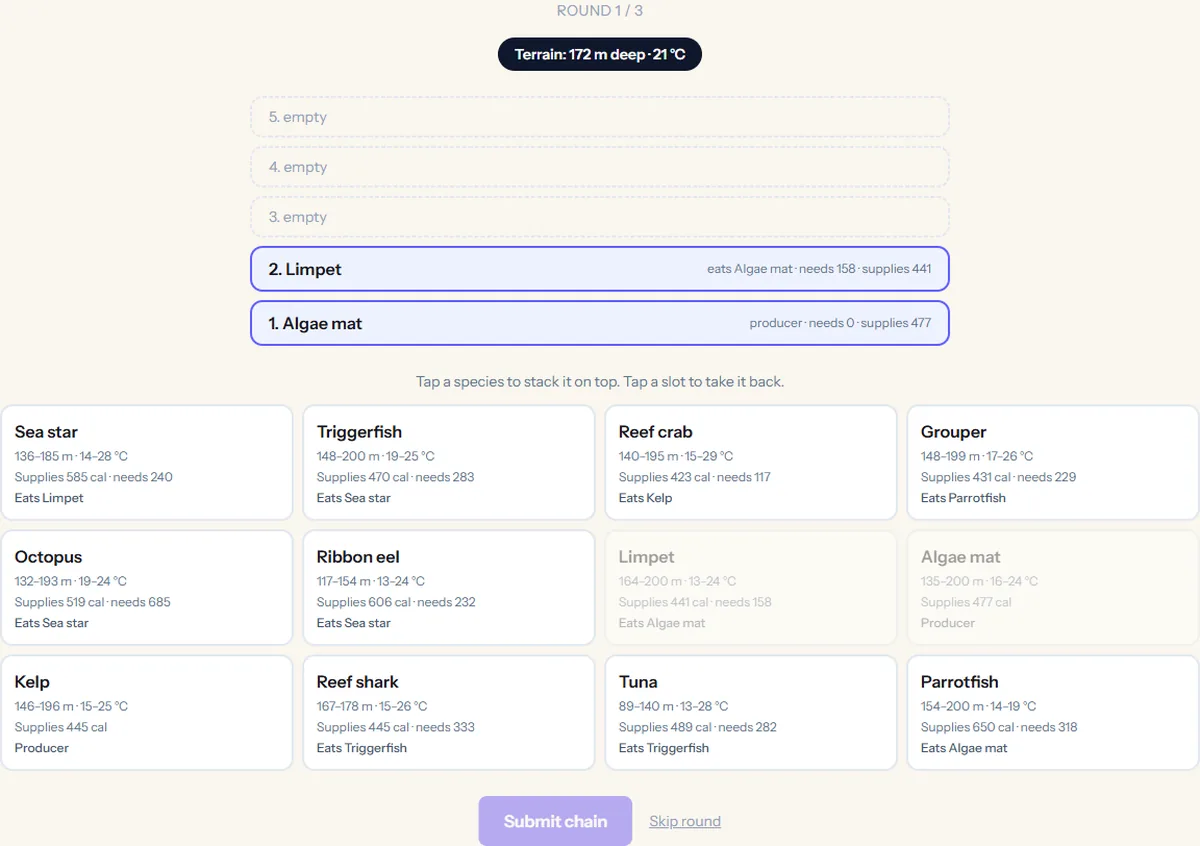
- Sea Wolf: pick microbes whose traits fit each site, an optimisation game. Guide.
- Sustainable Futures Lab: on longer invitations. See the Solve guide.
- Ecosystem Building and Plant Defense: older scenarios, now rarely reported. Ecosystem game, Ecosystem guide, Plant Defense guide.
Cappfinity and SHL
Cappfinity builds "branded, immersive experiences" (Cappfinity): strengths and situational scenarios plus numerical and verbal reasoning, often under the employer's name. Practise the parts with our situational judgement, numerical and verbal reasoning tests; see the Cappfinity guide.
SHL is mostly a question-based publisher, but candidates also meet its interactive reasoning tasks. Our SHL interactive assessment guide covers those, and the SHL practice test guide covers the classic sections.
Which classic lab tasks sit behind these games?
Many games are versions of decades-old psychology tasks, and you will see them under different names across vendors:
- Stroop (name the ink, not the word): attention and interference control. Stroop test, guide.
- Flanker (follow the middle arrow): attention. Guide.
- N-back (was this shown two steps ago?): working memory. Guide.
- Corsi blocks (repeat a sequence of taps): spatial memory. Corsi test, guide.
- Task switching (the rule keeps changing): flexibility. Task switching.
- Reaction time: processing speed. Reaction time test, norms.
How should you prepare for game-based assessments?
- Find out which vendor you have. The invitation email or link names it.
- Play the cognitive games two or three times each. Our data shows most of the gain arrives by the third attempt: see does practice improve assessment scores, and the real score spreads on score benchmarks.
- Play the behavioural games once, for the format. There is no high score on a balloon or fairness game; consistency matters more.
- Use the vendor's official practice where it exists. Arctic Shores has a practice task inside the assessment, and Criteria, Aon and SHL publish practice material.
For whether these games are a fair way to hire, see are game-based assessments fair; for the full picture in one place, the complete game-based assessment guide.
FAQ
What are examples of game-based assessments? The pymetrics games (Balloons, Digits, Arrows, Tower), HireVue's games (Numerosity, Shapedance, Pathfinder), Arctic Shores' tasks (Predict, Balance, Security, Ticket), Aon's gridChallenge, digitChallenge and switchChallenge, Criteria's Cognify, and McKinsey's Solve scenarios (Redrock Study, Sea Wolf).
What do game-based assessments measure? Two kinds of thing: abilities with right answers (working memory, attention, numerical and logical reasoning, planning) and behavioural tendencies with no right answer (risk-taking, fairness, persistence, how you learn from feedback). Employers compare the results with what their role needs.
Can you practise game-based assessments? Yes for the cognitive games, where familiarity and strategy raise scores. For the behavioural games, practice only teaches the format; playing as yourself is the honest and safer approach.
Which companies use game-based assessments? Vendors' own customer pages and employers' careers pages name users. Our employers page lists employer-by-employer guides, each with its sources.
Are game-based assessments timed? Usually per game. Harver puts the pymetrics set at about 25 minutes, Criteria's Cognify at about 10 minutes plus tutorials, HireVue's games at under 20 minutes each, and Arctic Shores' tasks at 5 to 15 minutes each.
GamePrep is an independent practice platform and is not affiliated with Harver (pymetrics), HireVue, Arctic Shores, Aon, Criteria, Cappfinity, SHL, McKinsey or any other assessment vendor. Our games are our own versions of publicly described task types, not copies of any vendor's games. We provide practice only — no leaked questions or answers.